



Thanks to Toby Culshaw, Carlos Politi, and Alex Soltani for their thoughtful edits and collaboration on this article.
“Best places to work” rankings suggest there is a single definition of a great employer. There isn’t. Value depends on perspective. Employees evaluate companies based on what matters to them, while employers evaluate value through business needs and priorities. In this article, I break the employee value proposition into measurable components and introduce a model that allows those priorities to be adjusted, showing how company rankings shift as you redefine what matters.
Some people care most about compensation. Others prioritize flexibility, strong leadership, meaningful work, or the chance to build valuable skills. Because priorities vary so widely, most “best places to work” rankings only tell part of the story.
That got me curious about what would happen if you broke the employee experience into its underlying components and let people decide which ones matter most to them.
To explore that idea, I analyzed Fortune 500 companies across twelve dimensions of the employee value proposition and built an interactive dashboard that allows users to adjust the importance of each factor. The rankings change quickly once priorities shift. The dataset used in this analysis is a modeled sample designed to illustrate the framework rather than a definitive ranking of employer quality.
In other words, instead of declaring a single list of the “best” employers, the goal is to make the tradeoffs visible and let people explore how companies compare depending on what they personally value in a workplace.
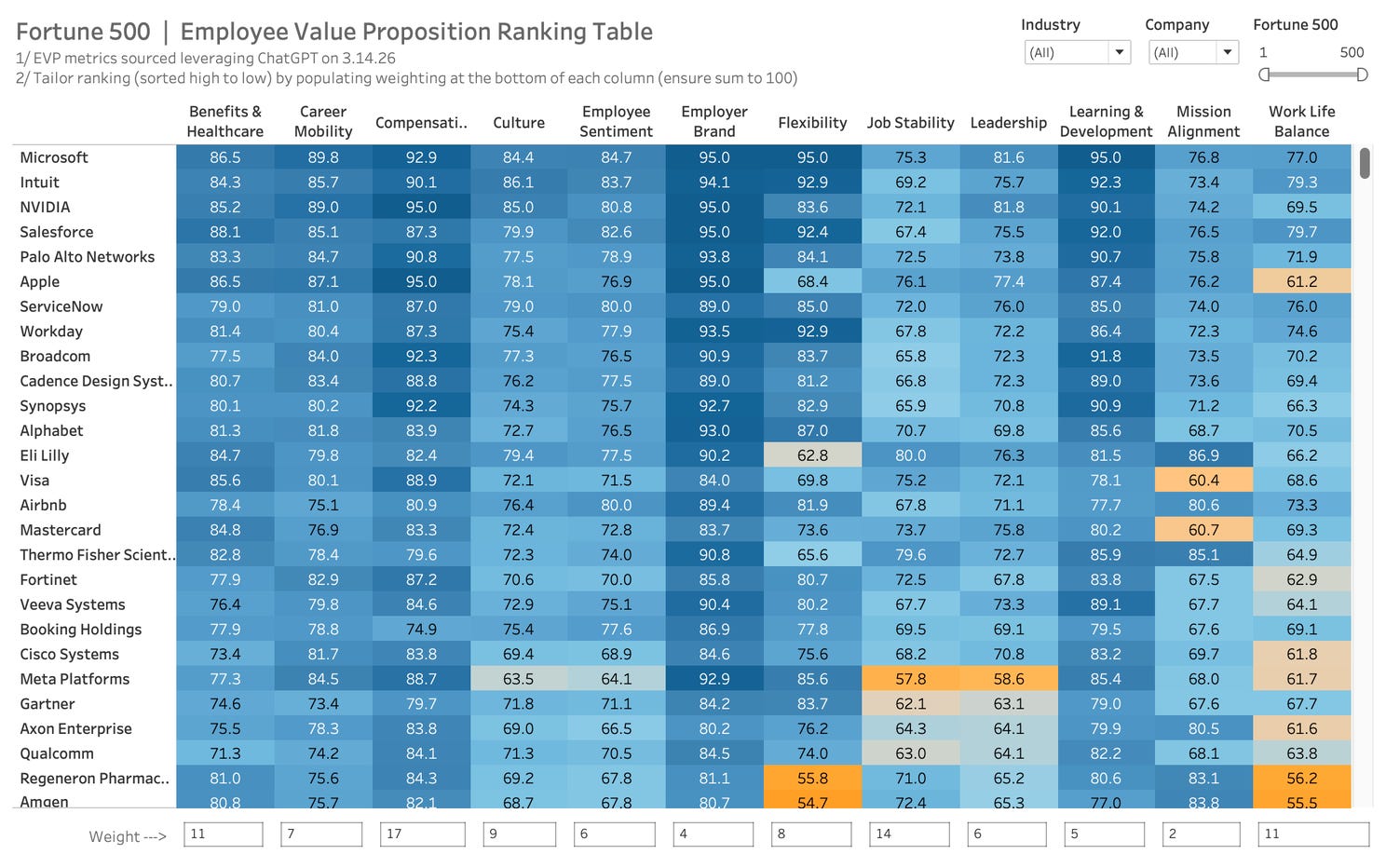
You can explore the interactive dashboard, sampled in Figure 1, here.
One clear outcome of the model is how dramatically company rankings shift when priorities change. Some companies that appear near the middle of the pack overall move close to the top when flexibility or leadership quality receive more weight, while others known for strong compensation fall quickly when career development or culture are emphasized.
This highlights an important point: the “best employer” often depends more on what an individual employee values most. A company that is an ideal environment for someone seeking rapid skill development might feel very different to someone prioritizing flexibility or stability.
It’s also worth noting that what employees prioritize shifts over time. During COVID, safety, health, and remote work dominated. Post-pandemic priorities have shifted. While flexibility and remote work remain high on the employee list, compensation has re-emerged as high priority for workers due to persistent inflation and cost-of-living pressures.
In some cases, external market factors can directly influence EVP dimensions in ways that are easy to overlook. At companies with heavily stock-based compensation models, share price can have a meaningful impact on both employee sentiment and candidate demand. When stock performs well, total compensation increases and employee perception often improves alongside it. When it declines, the opposite can occur, even if underlying job characteristics remain unchanged. This creates a dynamic where elements of EVP are partially shaped by forces outside the organization’s immediate control.
Cultural context shapes EVP allocation preferences. Individualistic employees prefer task performance-based equity (rewarding quality and productivity), while collectivistic employees prefer extra-role performance-based equity (rewarding effort and loyalty). Power distance orientation further influences preferences: low power distance employees value equal distribution, while high power distance employees accept status-based and hierarchical allocation criteria.
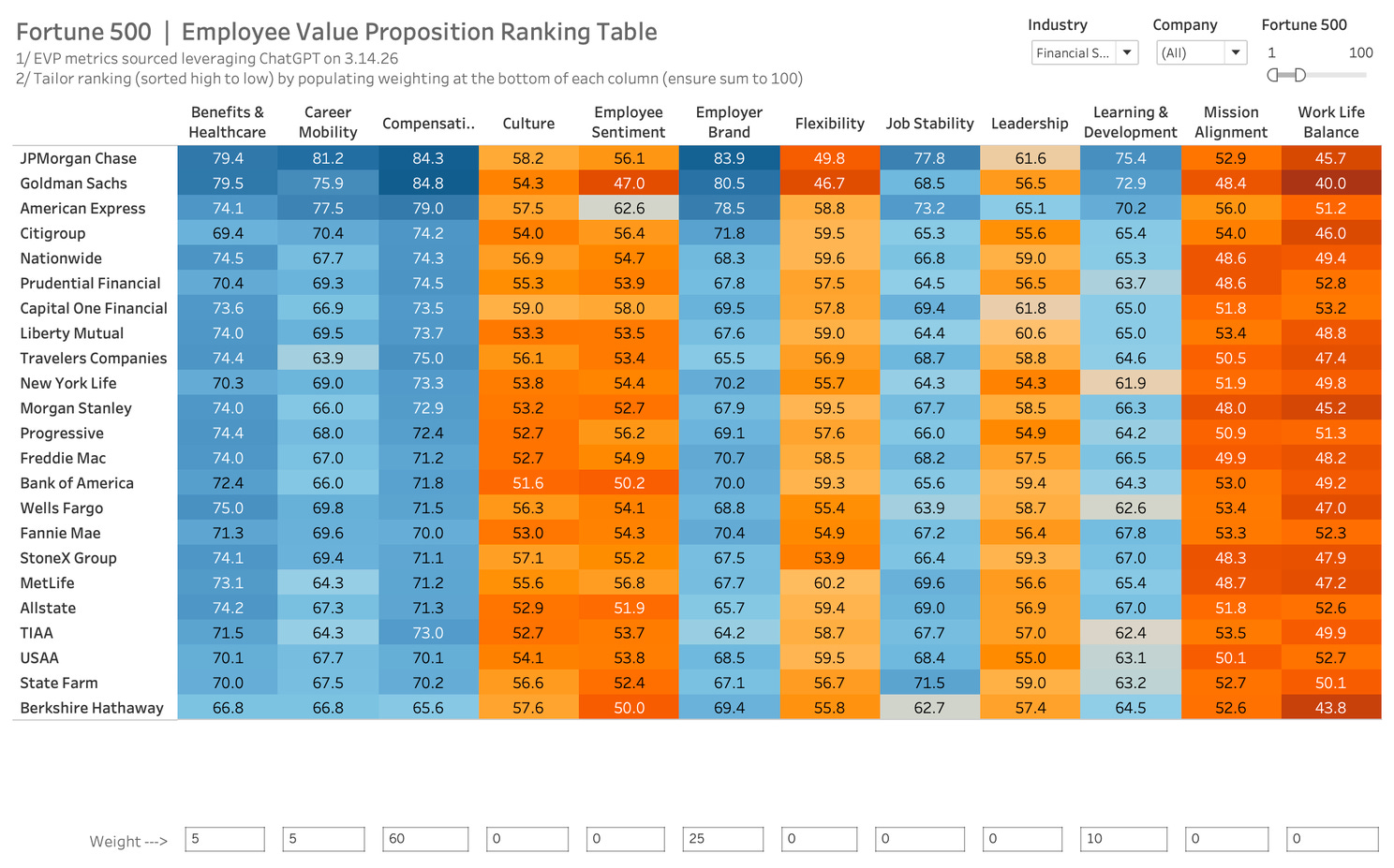
A demonstration of a tailored EVP view is shown in Figure 2. In this scenario, the dashboard is filtered to Financial Services firms within the Fortune 100, and the weighting is adjusted heavily toward compensation (60%) and employer brand (25%), with the remaining weight placed on learning and development (10%), benefits (5%), and career mobility (5%).
The main takeaway is that some lagging metrics matter very little when they carry little or no weight in the evaluation. In this example, several dimensions shown in orange represent weaker performance areas, but because those dimensions are not prioritized in the weighting scheme, they have minimal influence on the final ranking.
As priorities change, the same company can move significantly up or down in the rankings. A firm that appears average under equal weighting can quickly become a top performer when the dimensions most important to a particular employee are emphasized.
This illustrates why static “best employer” rankings often fail to capture individual preferences. What matters most is not necessarily how a company performs on every dimension, but how it performs on the dimensions that matter most to the individual evaluating it.
I would be curious to hear how others would weight these dimensions. If you could adjust the sliders yourself, which factors would matter most to you when evaluating an employer?
What Is an Employee Value Proposition?
An Employee Value Proposition, often shortened to EVP, describes the overall value an organization offers employees in exchange for their work. It is the combination of compensation, benefits, leadership, culture, flexibility, development opportunities, and mission that together shape the employee experience.
For many years, conversations about EVP were heavily centered on pay and benefits. Those factors still matter, but the modern workforce evaluates employers across a much broader set of dimensions.
Flexibility, leadership quality, learning opportunities, and work life balance increasingly influence how people evaluate potential employers. In many cases, these factors shape day-to-day satisfaction more than compensation alone.
The competitive landscape of EVP itself evolves over time. Consider how some companies introduced office perks (e.g., cafeterias, fitness classes, laundry services) that became industry expectations. Years later, many of these firms reduced these ‘table stakes’ benefits to cut costs. This illustrates that dimensions become baseline, then get cut. Organizations compete not just on dimension performance, but on which dimensions are even available.
Research backs this up. LinkedIn’s Global Talent Trends research found that 94 percent of employees say they would stay longer at a company that invests in their career development. Gallup has also found that roughly 70 percent of the variance in employee engagement can be attributed to the manager, highlighting how strongly leadership quality influences the employee experience.
Because of this, two companies offering similar pay can feel completely different as places to work. Differences in leadership, culture, flexibility, or growth opportunities often determine whether employees stay and thrive or eventually decide to leave.
For organizations competing for talent, understanding and shaping these factors has become increasingly important.
Why EVP Matters From the Employee Perspective
Choosing where to work is one of the most consequential decisions most people make during their careers. According to the U.S. Bureau of Labor Statistics, the average full-time worker spends more than 90,000 hours working over the course of their lifetime. That means the quality of the work environment can have an enormous impact on overall well-being.
When people choose the wrong environment, the effects can go well beyond compensation. Research from MIT Sloan analyzing millions of employee reviews found that workplace culture is one of the strongest predictors of voluntary turnover, often outweighing compensation in employees’ decisions to stay or leave.
Because of this, many professionals now look at potential employers through a much broader lens. Some prioritize flexibility and autonomy, especially as hybrid and remote work have become more common. Others focus on career mobility and the chance to build skills that increase long-term earning potential. For some, leadership quality or meaningful work are the most important factors.
The challenge is that these priorities vary widely from person to person.
A company that ranks highly in a traditional “best employer” list might perform well on compensation but poorly on flexibility or career development. For someone who values flexibility above all else, that organization might not actually be a great fit.
This is where a more flexible EVP framework becomes useful. Instead of assuming everyone values the same things, the model allows individuals to adjust the importance of each dimension and see how rankings change. Someone focused on flexibility can weight that dimension more heavily. Someone else focused on career growth or compensation can do the same.
The result is a more personalized way to evaluate employers.
Why EVP Matters From the Employer Perspective
From an employer’s perspective, this talent proposition becomes the organization’s competitive strategy in the labor market.
Most companies devote enormous analytical effort to understanding how they compete for customers. Far fewer take the same structured approach when it comes to competing for talent.
Yet the financial stakes are substantial. Research from the Society for Human Resource Management estimates that replacing an employee can cost between 50 percent and 200 percent of that employee’s annual salary, depending on the complexity of the role. These costs include recruiting expenses, onboarding time, lost productivity, and the loss of institutional knowledge.
Employee engagement also has measurable effects on business performance. Gallup’s analysis of organizations worldwide has shown that companies with highly engaged employees experience 23 percent higher profitability, 18 percent higher productivity in sales, and significantly lower turnover compared with those where engagement is low.
Because of these impacts, understanding how an organization compares with competitors across dimensions such as compensation, flexibility, leadership, and development opportunities is not simply a cultural exercise. It is a strategic capability that influences an organization’s ability to attract and retain talent.
Looking at EVP through a structured framework helps organizations answer practical questions. How does our talent proposition compare with companies competing for the same skills? Where do we lead peers, and where do we lag behind? Which improvements might meaningfully strengthen our ability to recruit and retain great people?
These insights can help guide investments in the employee experience more effectively. In practice, this type of framework can also help organizations understand how their talent proposition compares with competitors targeting the same skills.
How the Data Was Built
To explore these questions, I constructed a dataset evaluating Fortune 500 companies across twelve dimensions of the employee value proposition. These dimensions include factors such as compensation competitiveness, workplace flexibility, leadership quality, career mobility, learning opportunities, mission alignment, and employee sentiment.
Large language models were used to assist with gathering and structuring information across these categories, drawing on a combination of publicly available sources and modeled signals.
First, employee sentiment indicators from publicly available sources were used to estimate how employees perceive aspects of the workplace experience such as culture, leadership quality, and development opportunities. While no single dataset perfectly captures employee sentiment, combining multiple signals helps approximate how organizations are perceived by their workforce.
Second, structural factors such as workplace flexibility were modeled using known company policies and industry norms. For example, organizations with strict five-day in-office requirements generally receive lower flexibility scores than companies with hybrid or remote work models.
Third, all metrics were normalized to a common scale so companies could be compared consistently across industries. This allows organizations in sectors such as technology, finance, manufacturing, and healthcare to be evaluated within a common framework.
The default weighting in the dashboard was designed to represent a balanced view of the employee value proposition rather than a definitive ranking formula. Each dimension was evaluated based on how strongly it tends to influence employee decision-making, how frequently it appears in workforce research and employee surveys, and how directly it affects the day-to-day employee experience.
Insights from workforce research published by organizations such as Gallup, LinkedIn, and MIT Sloan were used as directional signals when assigning baseline weights. Dimensions consistently associated with employee engagement and retention, such as leadership quality, career development, and compensation, received slightly higher weights, while other factors such as mission alignment or employer brand received more moderate weighting.
The goal is not to claim a single correct formula for evaluating employers. Instead, the default weighting provides a reasonable starting point that users can adjust to reflect their own priorities.
It is important to note that this dataset should be viewed as a structured demonstration rather than a definitive measurement of employer quality. Large language models are useful for synthesizing publicly available information and generating structured datasets, but they cannot replace a fully engineered data pipeline built from primary data sources.
The LLM-assisted approach provides several strengths. It allows the framework to be constructed quickly, creates a consistent structure across companies, and enables experimentation with weighting different aspects of the employee experience. For exploratory analysis or prototyping dashboards, this approach can be surprisingly effective.
At the same time, the model relies on approximated signals rather than direct measurements for many companies. Employee sentiment, leadership quality, and development opportunities were inferred from a combination of public sentiment indicators, company reputation signals, and industry context rather than a single comprehensive dataset. Timing of content also lags. For instance, Fortune 500 rankings of the companies in the study are not for the current year.
A more robust implementation would incorporate additional structured data sources. These could include large-scale employee review datasets, compensation benchmarks, workforce mobility indicators, and company-level policy data such as remote work practices. Building a pipeline that integrates these sources would require significantly more engineering effort but would produce a more precise and continuously updated model of employer comparisons.
In other words, the goal of this project is not to produce a definitive ranking of Fortune 500 employers, but to demonstrate how employee value propositions can be analyzed as a multi-dimensional system where tradeoffs become visible when priorities shift.
Reproducing the Analysis
One of the goals of this project was transparency and reproducibility.
The dataset and scoring approach can be recreated using modern large language models by following a structured prompt that defines how companies should be evaluated, how scores should be normalized, and how EVP dimensions should be represented in the final dataset.
For those interested in replicating or experimenting with the analysis, the prompt used to generate the dataset is available here.
Because LLM-generated datasets may vary depending on the model and prompt used, reproducing the analysis with different models can also serve as a useful experiment in how generative systems interpret and structure workforce data.
Providing the prompt allows others to reproduce the analysis in their own environment, compare results across models, or experiment with alternative weighting schemes and datasets.
Closing Thoughts
The idea of an Employee Value Proposition has been around for many years, but the ability to analyze it with data is still evolving.
By translating aspects of the employee experience into measurable signals, even imperfect ones, it becomes possible to compare employers in a more transparent and flexible way. For employees, this approach can help identify organizations that align with their priorities and career goals. For employers, it offers insight into how their talent proposition compares with competitors.
Ultimately, what makes a great employer depends heavily on what individuals value most. Some prioritize compensation, others flexibility, leadership quality, career growth, or meaningful work. A single ranking cannot capture all of these perspectives.
Allowing those priorities to change makes the tradeoffs visible and highlights how different definitions of a great employer lead to different conclusions.
Disclaimer: The views and opinions expressed in this article are solely those of the author and do not reflect the official policy or position of any current or former employer. Any content provided in this article is for informational purposes only and should not be taken as professional advice.